
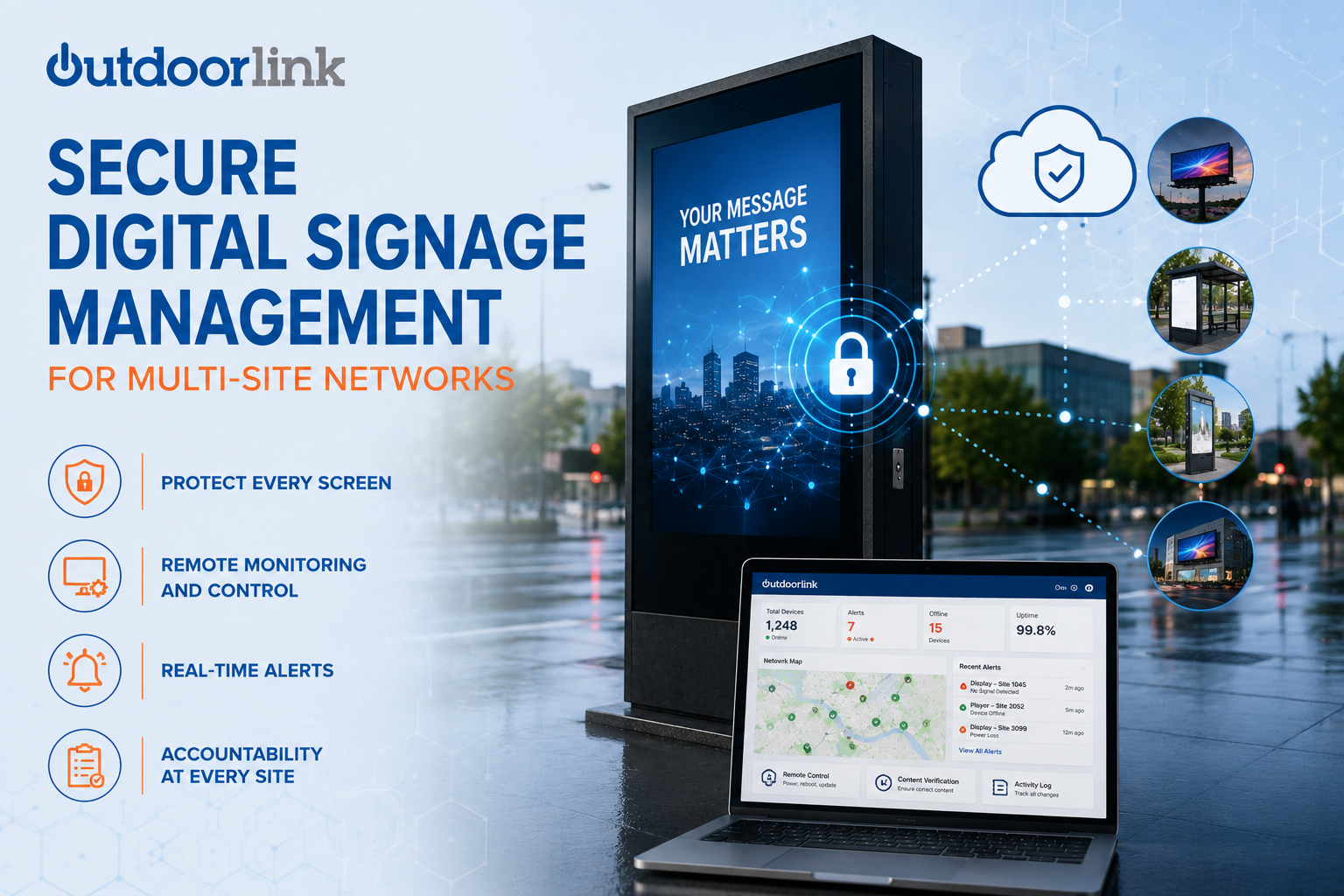
Secure Digital Signage Management for Growing Multi-Site Networks
Secure digital signage management is the practice of controlling access to, and monitoring the health of, every screen and controller across a distributed network, so no location becomes an unmonitored entry point. Every new screen, store, or site adds another device sitting in the open, another connection point, and another chance for tampering or downtime. Add a summer promotion push or holiday travel traffic, and the number of screens running unattended grows right along with the risk.
An unsecured digital sign isn’t just a screen problem. It can become an access point into the broader network, a target for content hijacking, or the reason a brand shows the wrong message at the worst possible time. For organizations managing signage, lighting, and outdoor infrastructure across many sites, secure control isn’t a nice-to-have. It’s baseline operational safety.
Where Multi-Site Signage Networks Are Most Exposed
Digital signs get less security attention than office servers or point-of-sale systems, but they’re often easier to reach and easier to forget. That gap goes unnoticed until something goes wrong.
Common weak points across multi-site signage networks:
- Media players that never receive firmware updates
- Screens running on open or poorly secured Wi-Fi
- Shared logins reused across many locations
- Devices installed outdoors or in semi-public spots where ports and power are exposed
Peak seasons make this worse. Longer daylight hours, outdoor events, and travel-driven campaigns mean more screens, pop-up displays, and temporary signage running at once, each one a new access point if controls are weak.
Operational blind spots compound the risk. Teams often can’t quickly answer:
- Which screens are online right now?
- Who changed this playlist, and when?
- Which locations are still running outdated firmware or schedules?
Without that visibility, incidents run longer than they should: tampered or incorrect content stays live, regional messaging goes out of sync, and resolving it often means an expensive truck roll just to reboot one device.
What Secure Digital Signage Management Actually Requires
Security isn’t one tool. It’s connectivity, access control, and monitoring working together across every site.
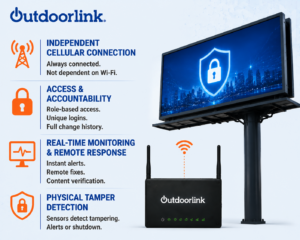
Connectivity that doesn’t depend on the client’s network. Signage controllers that run on their own independent cellular connection, rather than sitting on a facility’s Wi-Fi, remove one of the most common entry points into a shared network. Outdoorlink’s controllers connect this way by design, giving 24/7 monitoring that isn’t dependent on, or exposed through, a site’s existing infrastructure.
Access and accountability. Every change should be traceable to a user, a time, and a site. That means role-based permissions, unique logins instead of shared credentials, and a change history that can be pulled for an audit without a manual review.
Real-time monitoring and remote response. At this scale, manual checks don’t hold up. What does:
- Real-time health checks on power, connectivity, and player status
- Instant alerts when a device goes offline or behaves unexpectedly
- Remote reboot and power-cycling to resolve most issues without a site visit
- Content verification confirming the right message is actually on screen, not just that the system reports “online”
Physical tamper detection. Cabinet doors, motion, and beam sensors, deployable through Outdoorlink’s Intrusion Kit, catch unauthorized access attempts and can trigger an automatic shutdown or alert before damage or tampering occurs.
Washington Union Station’s digital network is a working example: Outdoorlink’s Vantage system uses an optical sensor to verify displayed content matches the intended input, with built-in safeguards against unauthorized or tampered content, delivering 100% uptime across 26 UHD screens and six large LED displays in one of the busiest transit hubs in the country.
Building a Signage Network That Scales Securely
A future-ready signage rollout runs on a repeatable playbook, not a one-off setup per site:
- Consistent hardware profiles instead of a mix of ad hoc players
- Approved firmware versions with a clear, scheduled update path
- Central policies for content timing, brightness, and allowed applications
Unifying signage with lighting and other outdoor infrastructure under one platform also cuts vendor sprawl. IT, facilities, and marketing work from the same source of truth instead of juggling separate systems.
Resilience matters just as much as prevention. Remote diagnostics that isolate whether an issue is power, network, or content, and safe power-cycling from a central console, mean seasonal campaigns, new store openings, and temporary event signage can follow the same secure template every time.
What to Ask Before Choosing a Signage Platform
Before committing to a controller or platform, ask vendors directly about:
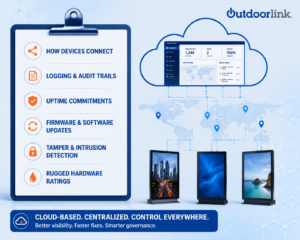
- How devices connect, and whether that connection depends on the client’s own network
- Logging and audit trails, and how long records are retained
- Uptime commitments and how outages are detected and resolved
- How firmware and software updates are tested and rolled out
- Support for tamper and intrusion detection on physical hardware
- Rugged hardware ratings for heat, cold, and moisture in outdoor deployments
Cloud-based, centralized platforms generally outperform local-only control as site counts grow, offering better visibility across every location, faster fixes pushed from one place, and governance that applies network-wide instead of site by site.
Turn Your Signage Network Into a Secure Asset
Moving from scattered, manually managed screens to centralized, secure management turns the network into an asset instead of a risk. A quick internal audit is a good starting point:
- Players no one is actively managing
- Shared passwords and untracked logins
- Sites with no record of current firmware or schedule
- Locations with no remote visibility into power or status
Ready to gain real visibility and control across your signage network? Contact Outdoorlink to talk through your deployment and see how centralized monitoring, remote control, and tamper detection fit your operation.