
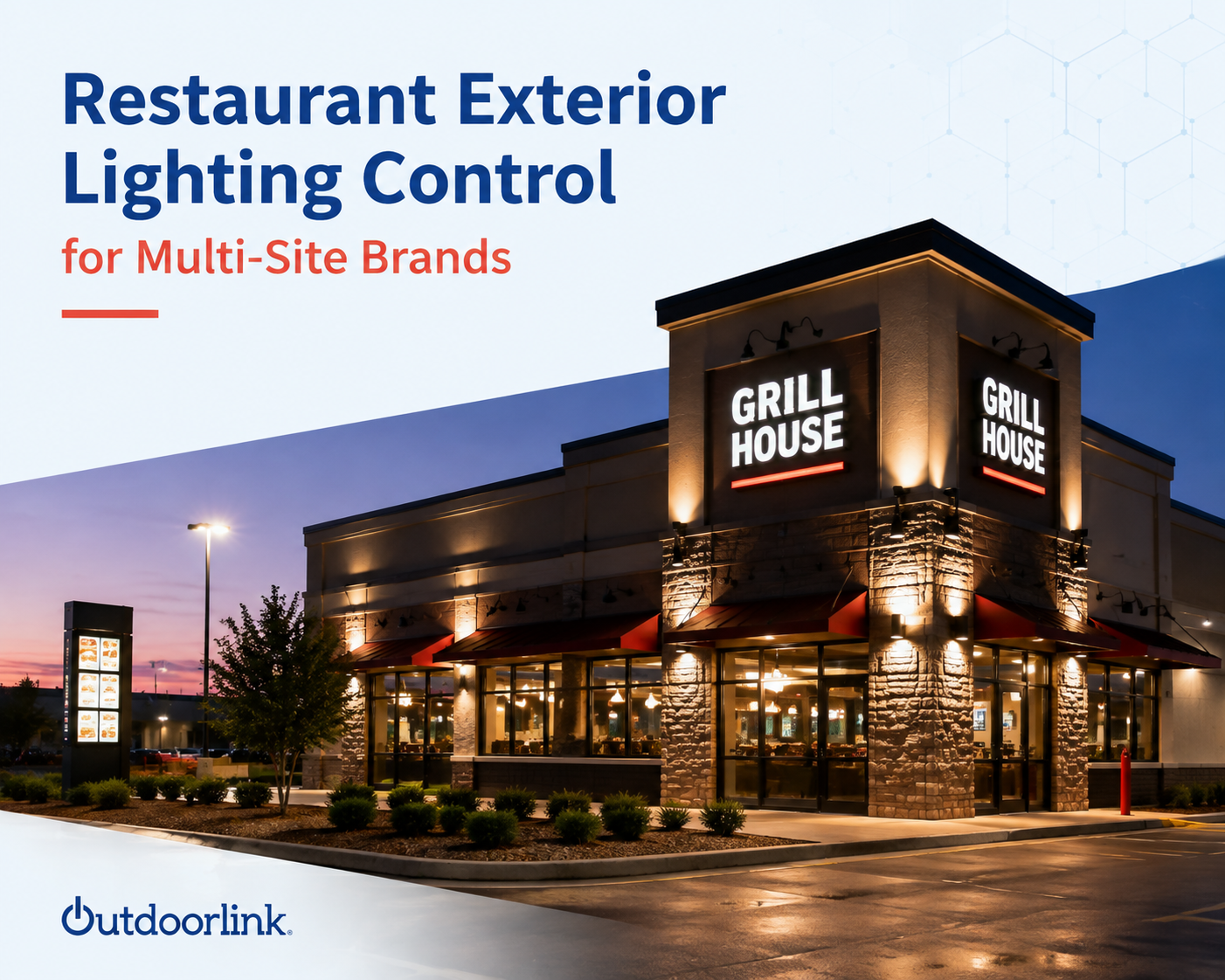
Restaurant Exterior Lighting Control for Multi-Site Brands
Restaurant exterior lighting control is the use of remote, schedulable lighting systems, rather than photocells and mechanical time clocks, to manage parking lots, signage, entries, and drive-thrus consistently across every location. At scale, old-style timers lead to lights turning on too early, staying on too late, or failing without anyone noticing until a guest complains. A centralized approach fixes that across dozens or hundreds of sites at once.
Why Exterior Lighting Consistency Matters Across a Multi-Site Brand
A guest’s first impression of a restaurant happens in the parking lot. A consistently lit exterior, with signage, facades, and walkways lit the same way at every location, signals reliability before a guest walks in the door.
Consistent exterior lighting control supports:
- A uniform brand image from golden hour into late night
- Fewer dark patches or shadowed zones near entries and drive-thru paths
- Logos and signage that stay visible and on-brand from the road
Safety and liability follow the same logic. Dark zones near curbs, steps, or drive-thru lanes raise the risk of trips, falls, and security incidents. Local dark-sky and lighting ordinances also change over time. Centralized control makes it possible to adjust curfews, dim non-critical zones, or respond to a code change across the network without a single site visit.
On the operations side, time clocks and photocells carry hidden labor cost. Someone resets them after storms, power blips, and Daylight Saving Time. Someone walks the lot to find which circuit failed. Remote control removes those manual checks and gives facilities teams accurate, real-time status from one platform instead of a hundred separate panels.
Designing the System: Zoning and Standardization
Effective restaurant exterior lighting control starts with zoning rather than running the entire exterior on one schedule. Typical zones include:
- Parking lots and perimeter poles
- Building accent lighting and wall packs
- Building and roadside signage
- Drive-thru lanes and menu boards
- Patios, pickup areas, and side entrances
Zoning lets safety-critical areas, like drive-thru lanes and entry paths, stay fully lit while decorative or accent loads dim or shut off after curfew.
Multi-relay controllers make this practical at scale. Cotting School, for example, runs 13 Outdoorlink controllers with 4 relays each, remotely managing 52 circuits across interior and exterior lighting from a single phone or computer, adjusting instantly for school breaks, holidays, and special events. The same zoning approach applies directly to a restaurant network managing parking lots, signage, and patios as separate, independently schedulable circuits.
Standardizing controller placement and naming across every new build and remodel means facilities teams and service partners always know exactly where to look, whether the store is corporate-owned or franchised.
Features That Make Multi-Site Control Work
GPS-based sunrise and sunset scheduling keeps lighting accurate across regions and time zones without manual adjustment, and automatic Daylight Saving Time updates keep every site in sync without a local manager touching a dial.
Real-time power monitoring and outage alerts turn the network from reactive to proactive. Instant notifications for bulb faults or power loss mean a service call can be scheduled before a weekend or holiday rush, not after a guest complains about a dark sign.
Remote power-cycling for signage and digital displays brings menu boards and digital signage onto the same platform as lighting, so a frozen board or dark sign can be reset remotely instead of triggering a truck roll.
As Deborah Wilson at Julio Jones Kia put it: “It’s so easy to do from my phone app or my computer website.” That’s the standard multi-site groups should expect, changing a schedule across every location without touching a panel.
Seasonal, Promotional, and Late-Night Scheduling
Guest patterns shift by season, longer patio hours in summer, earlier sunsets and icy walkways in winter, and a scheduling platform should shift with them. That includes region-specific sunset times, seasonal patio and pickup patterns, and extra lighting at icy curbs when conditions call for it.
The same flexibility supports marketing. Coordinated lighting timing for seasonal promos, highlighted entrances for curbside pickup events, or extended-hours scenes for game days all run from the same schedule that already manages daily operations. Melissa Patch at Coldwell Banker described the same principle applied to a commercial property: “I know my lights turn on at exact sunset and off at exact sunrise.”
Rolling Out Across a Multi-Site Network
A cross-functional group, facilities, operations, marketing, IT, and franchise leadership where relevant, should define zones, brightness targets, curfews, and safety rules before hardware selection begins.
From there, a pilot-then-scale approach works best: start with a mix of suburban, urban, highway, corporate, and franchise locations, refine zoning and alert rules based on what those pilots surface, then document the result as a standard playbook, specs, wiring diagrams, and training, so every new location deploys the same way.
Ready to bring every location’s exterior lighting onto one platform? Contact Outdoorlink to talk through a rollout plan that fits your network.