
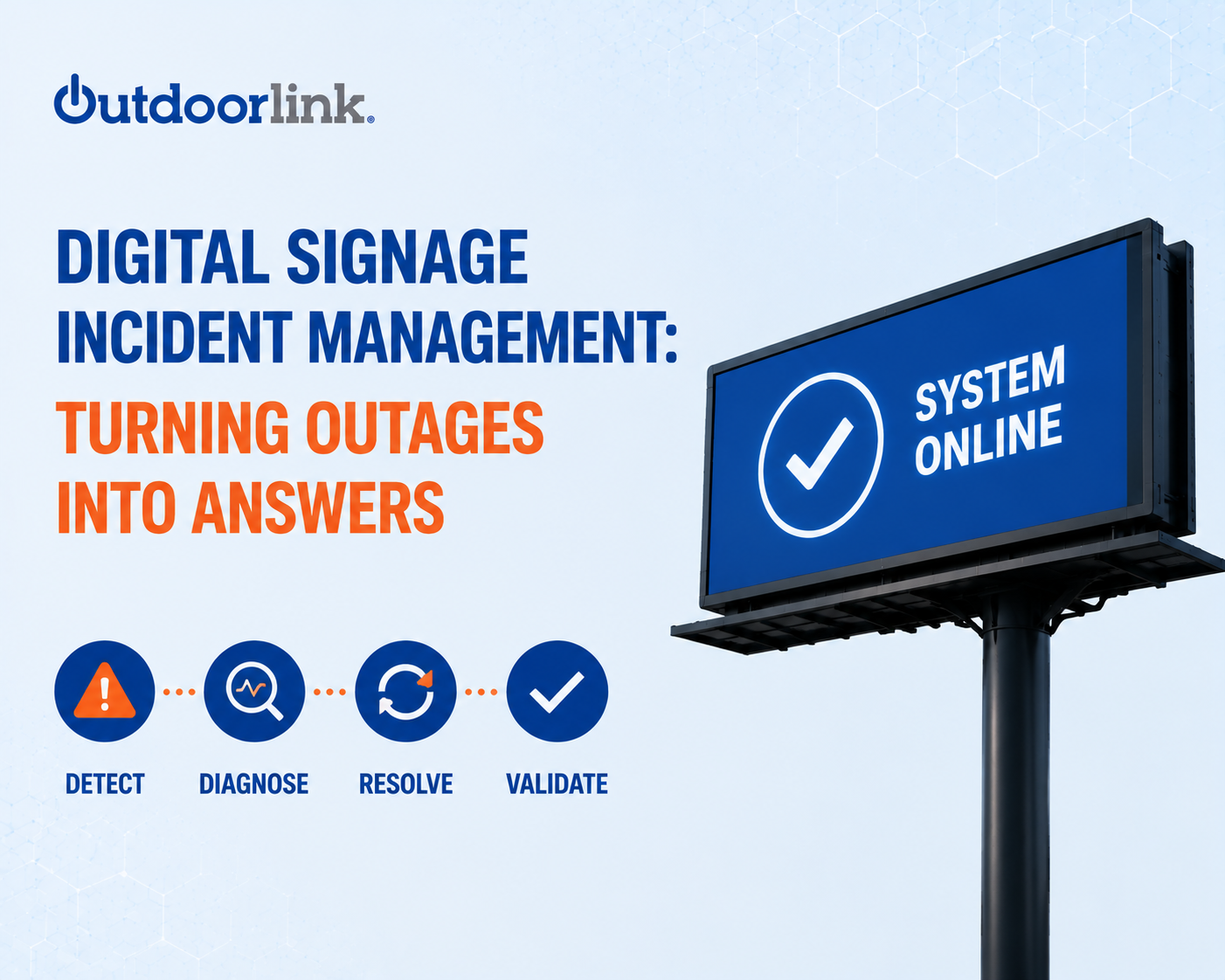
Digital Signage Incident Management: Turning Outages Into Answers
Digital signage incident management is the process of using remote diagnostics, power telemetry, and device-level checks to determine exactly why a display failed, rather than just resetting it and moving on. Black screens, frozen content, or dim displays don’t just look bad. They break trust with advertisers, confuse visitors, and waste premium screen time during the busiest hours. When it happens mid-concert, mid-event, or during a tourist rush, every minute the root cause stays unknown is a minute of lost revenue and lost confidence.
No network stops every storm or heat wave. What separates a resilient network from a reactive one is whether each incident produces an answer or just a reboot.
Why Peak Season Raises the Stakes
Outdoor digital networks feel seasonal pressure hardest. Heat pushes hardware to its limits, storms cause power spikes and brownouts, and longer daylight hours push brightness and cooling demands higher. All of that lands right when ad slots and sponsorships are worth the most.
Fast, accurate root-cause work after each incident protects:
- Service level commitments, with fewer surprise outages
- Full delivery on booked ad campaigns
- Brand trust, especially when crowds and cameras are watching
The findings also compound. Repeat brownouts on one circuit point to a surge protection or cabinet upgrade. Failures that track with high temperatures point to enclosure or airflow changes for the next deployment cycle. Each incident becomes an input into how the next rollout gets built.

The Diagnostic Data Already Sitting in Your Network
Modern signage networks already generate the signals needed to answer “what happened, and why.” The work is in reading them together instead of guessing.
Power telemetry shows voltage, current, and on/off cycles before and during an outage, and usually points directly to the source:
- Utility-side trouble, such as low voltage hitting several sites at once
- A local cabinet issue, like a bad breaker or loose neutral
- A failing component drawing abnormal current before it dies
Instant outage alerts flag power loss the moment it happens, rather than waiting for a client or passerby to report a dark screen.
Hardware and content verification narrows the fault to a specific point in the chain. Outdoorlink’s Vantage system, for example, checks:
- No Display Detected: screen failure, screen unplugged, or a disconnected cable
- No Video Input: the player is off or has failed
- No Video Output: a screen failure, wrong input, or display issue
- Static Screen Alarm: a frozen screen or ad-rotation malfunction, confirmed with a Screen Grab pulled directly to the portal for review
Read together, power data and hardware verification usually answer the question fast: did voltage sag first, then the screen go dark? Or did the screen freeze while power stayed clean? That distinction points straight to power or to the device stack, without a technician standing on site guessing.
Turning a Multi-Vendor Network Into Clear Accountability
Multi-vendor deployments make root cause harder, not easier, without independent monitoring per component. When the Kansas City Area Transportation Authority (KCATA) expanded its BRT kiosk network, monitoring each device (lighting, display, player, router) separately meant the responsible supplier could be identified immediately instead of guessed at, cutting site visits by 70% and maintenance costs by 60%.
That same independent, component-level visibility is what separates a fast fix from a finger-pointing exercise across vendors.
When Speed Matters Most: Recovering at Scale
Post-incident response isn’t only about routine outages. During the 2024 CrowdStrike outage, Outdoorlink’s remote monitoring and reboot tools recovered 98% of affected digital inventory remotely, without dispatching a single truck, in a fraction of the time a manual, site-by-site response would have taken. That’s the same capability, applied at emergency scale: diagnose remotely, act remotely, confirm the fix without guessing.
A Repeatable Playbook for Every Incident
A consistent process keeps a network calm when a screen isn’t:
- Detect: an alert fires from a power event or a failed verification check.
- Stabilize: attempt a remote reboot or power-cycle before considering a site visit.
- Diagnose: compare power telemetry against the hardware verification result to isolate power, player, or screen.
- Fix: apply the remote fix, or dispatch a technician with the right part already identified.
- Validate: confirm the display is back and stays back, using the same monitoring that caught the issue.
Clear ownership keeps it moving: operations owns the alert and diagnosis, field techs own on-site work only when remote fixes are exhausted, and every incident gets logged the same way so patterns become visible over time.
Turn Every Outage Into a Stronger Network
Every incident is a data point, especially during high-traffic, high-heat seasons. Treated as evidence instead of bad luck, that data builds a network that recovers faster and repeats fewer failures.
Outdoorlink’s Smart Controllers and Vantage system give operators real-time power monitoring, remote reboot, and hardware-level verification in one platform, so root cause is identified in minutes instead of after a truck roll.
Ready to turn reactive troubleshooting into fast, remote root-cause diagnosis? Contact Outdoorlink to review your current setup and see what’s possible for your network.