
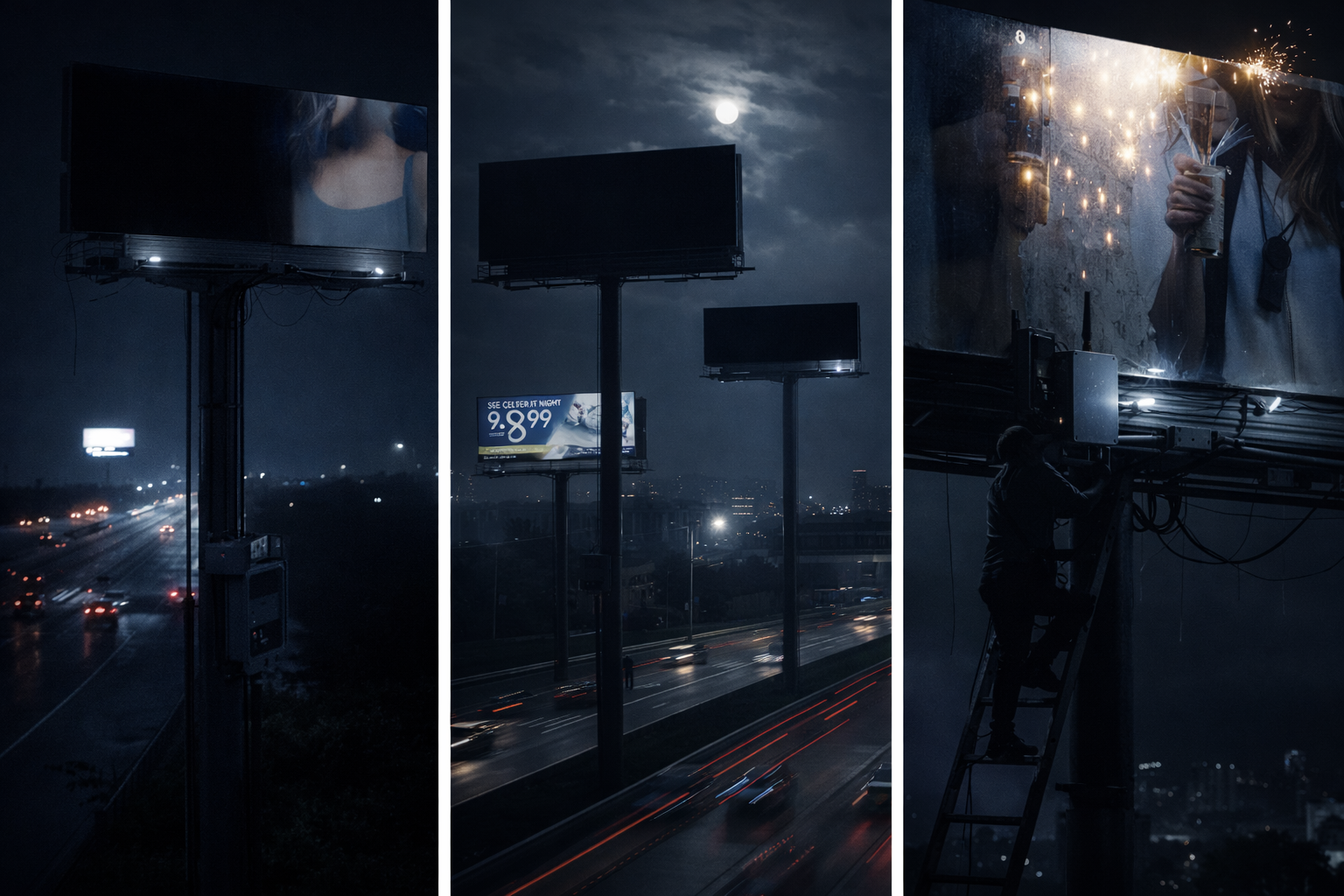
When Dark Billboards Put Your Brand at Risk
When your billboard goes dark during peak traffic, your message disappears while everything around it stays visible.
Cars still pass. Impressions are still there. Your board just is not.
Small lighting issues rarely start as major failures. They build quietly. As daylight shifts through spring and summer, timers drift, photocells lose accuracy, and schedules fall out of sync. What used to run clean starts slipping, and without visibility, those gaps go unnoticed until they impact performance.
What You Can See From the Road
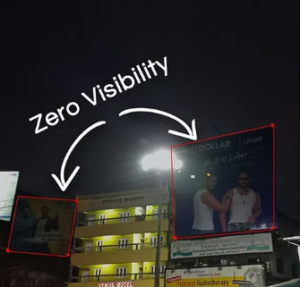
Some problems are obvious if you know what to look for.
- Lights turning on after it is already dark or shutting off too early
- Boards staying lit well into daylight
- Flickering, dim sections, or partial outages
You may also notice inconsistency across locations. One board fully lit, another still dark. A cluster that should look uniform but does not.
These are signs your system can turn power on and off, but it cannot maintain consistent performance.
What You Don’t See Is Costing You More
The bigger issues are not always visible.
Energy usage starts to drift. Lights run longer than needed, schedules miss seasonal changes, and there is no way to fine-tune performance across locations. Costs increase without a clear reason.
At the same time, your team spends more time reacting. Night calls, repeated service trips, and troubleshooting issues that should have been caught earlier become routine.
Without visibility, you are not fixing problems early. You are dealing with them after they have already impacted operations.
Where It Starts to Affect the Business
Lighting is not just operational. It is visible.
When it is inconsistent, it affects how your network is perceived. Advertisers expect reliability. If one board is dark while another is lit, confidence drops quickly.
For OOH networks, this directly impacts delivery. Missed lighting means missed visibility, and missed visibility means lost value.
Without clear data or proof of uptime, it becomes difficult to defend performance or show that issues were resolved quickly.
The Real Issue Is Lack of Visibility
Most lighting automation systems were not built for how operators run networks today.
They rely on local controls, fixed schedules, and manual updates. Over time, those systems drift. Each site behaves a little differently, and there is no clear way to manage everything at once.
If you only find out about issues after a call comes in, the system is reactive by default.
What Changes With Smarter Control
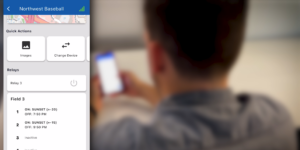
With centralized, remote management, lighting becomes something you can actually see and manage.
Schedules stay aligned across locations. Adjustments happen without sending someone into the field. Issues are flagged early instead of discovered late.
Instead of reacting to outages, you stay ahead of them.
Monitoring, alerts, and reporting also give you a clearer picture of performance. You know which sites need attention, where problems repeat, and how your network is actually operating over time.
Get Ahead of It Before It Costs You
As daylight hours shift, small issues become more noticeable and more costly.
If your team is still relying on manual checks, inconsistent schedules, or site-by-site fixes, it is worth taking a closer look at how your system is performing today.
When lighting is consistent, your network looks stronger, your operations run cleaner, and your advertisers see the difference.